
Apostille vs. Authentication Certificate: What’s the Difference and Which One Do You Need?
Both certify a U.S. document for use abroad, but for different countries. Here’s how to tell which one your document needs, what each is used for, and what to do if you received the wrong one.
We file both from Washington, D.C., and handle embassy legalization in-house for countries outside the Convention.
The short answer
- What do they have in common?
- Each one proves that the signature and seal on a U.S. public document are genuine, so a foreign government will accept it.
- What’s the difference?
- Countries in the 1961 Hague Apostille Convention accept an apostille on its own. Countries outside it require an authentication certificate, then a stamp from their embassy or consulate.
- Who decides which one I get?
- The destination. For federal documents such as an FBI background check, both come from the U.S. Department of State’s Office of Authentications, which matches the certificate to the country you list.
What is an apostille?
An apostille is a one-page certificate that lets a U.S. public document be used in countries that belong to the Hague Apostille Convention. The Convention had 130 parties as of June 2026. Once an apostille is attached, the receiving country can’t require any further legalization, because the treaty makes it the only formality allowed.
Every apostille follows the same model, so officials abroad can check it at a glance. It has 10 numbered items, and its title must be in French: “Apostille (Convention de La Haye du 5 octobre 1961).” It names the official who signed your document, the capacity they signed in, and the seal the document bears.
Who issues it depends on who signed the document. Documents signed by federal officials, such as an FBI background check, get their apostille from the U.S. Department of State. State-issued records, such as birth certificates and notarized papers, get theirs from that state’s Secretary of State.
What is an authentication certificate?
An authentication certificate is the State Department’s certificate for documents headed to countries outside the Hague Convention. It does the same basic job as an apostille. The difference is that it’s only the first link in a chain, not the end of it.
It also looks different. It opens with “To all to whom these presents shall come, Greetings” and is issued in the Secretary of State’s name. Instead of naming the official who signed your document, it certifies the issuing agency’s seal, such as the FBI’s, as entitled to “full faith and credit.”
After State issues it, the document goes to the destination country’s embassy or consulate in the U.S. for legalization. Some countries add one more step after arrival, such as a stamp from their foreign ministry. As of October 2026, this route applies to destinations such as the United Arab Emirates, Qatar, Kuwait, Egypt, Jordan and Thailand.
The list does change. Vietnam switched to apostilles on September 11, 2026, and its embassy in Washington stopped legalizing U.S. documents that day. Thailand is scheduled to make the same switch on February 28, 2027.
The two certificates side by side
Both certificates below were issued by the State Department in 2026 for the same kind of document, an FBI background check. The numbered markers show where they differ.
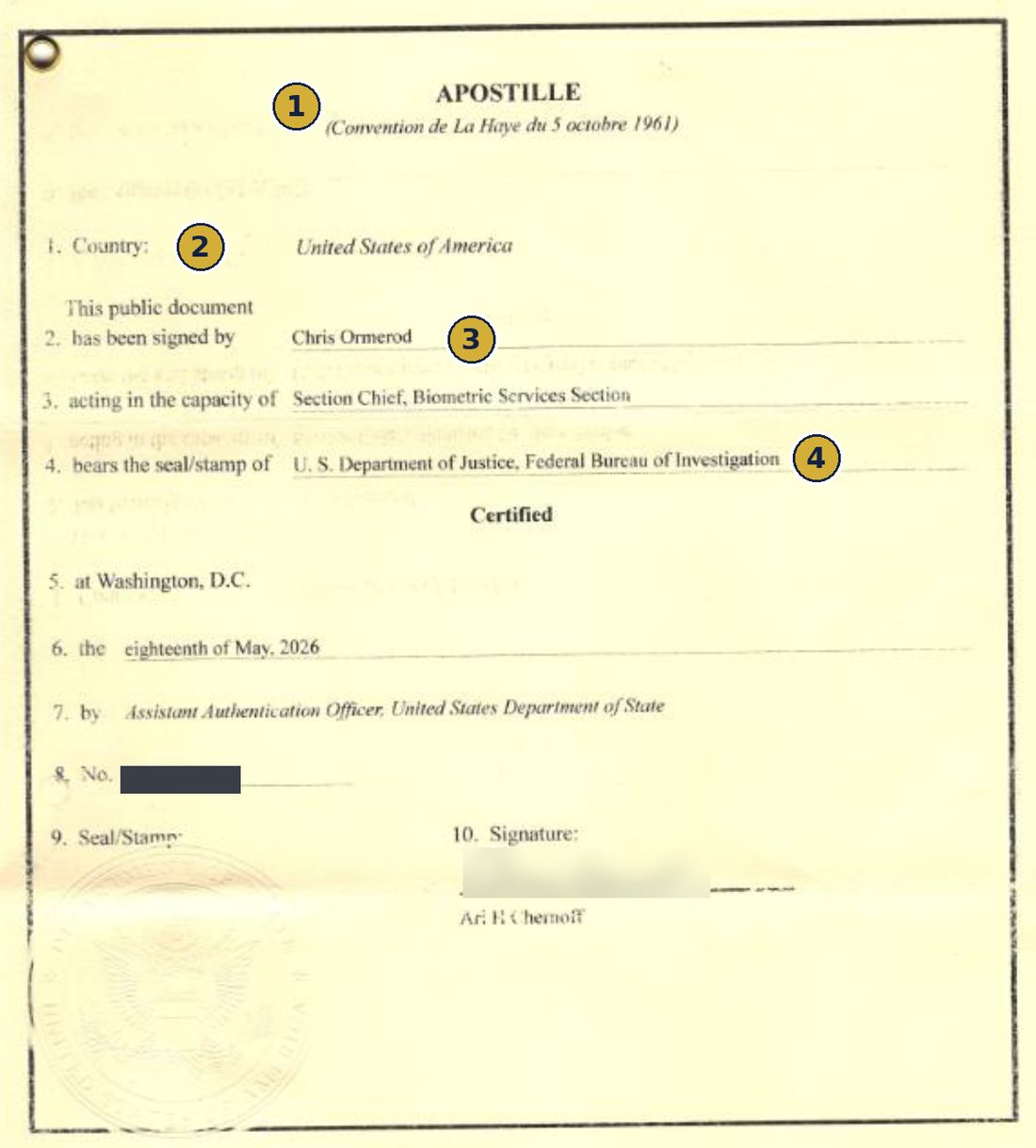
- Title in French, as the Convention requires
- Ten numbered fields in a fixed order
- Names the official who signed the document and the capacity they signed in
- Identifies the seal on the document, here the FBI’s
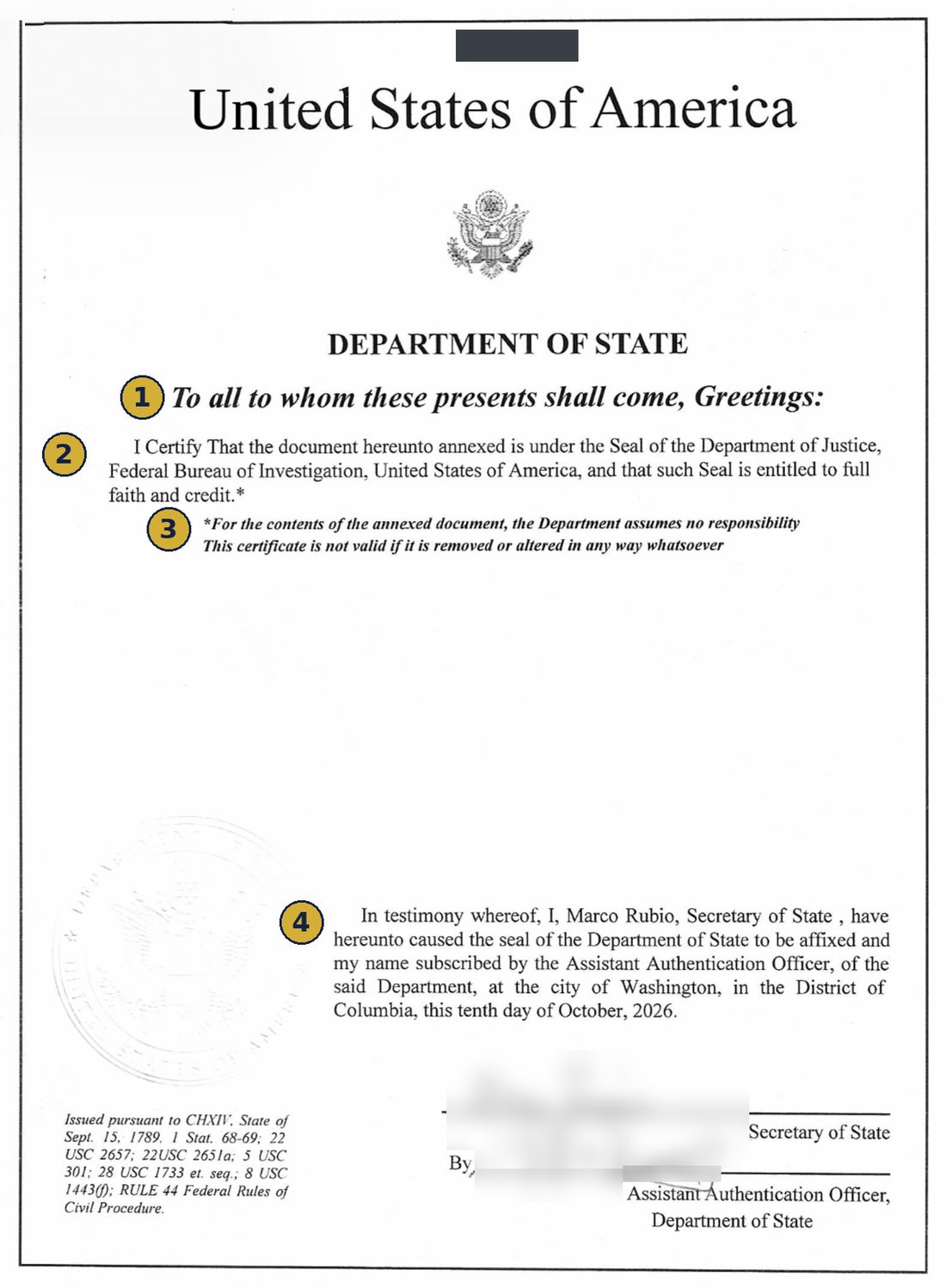
- Opens with “To all to whom these presents shall come, Greetings”
- Certifies the FBI’s seal instead of naming the official who signed
- Disclaims responsibility for the document’s contents
- Issued in the Secretary of State’s name and signed by an Assistant Authentication Officer
Certificate numbers and signatures are redacted, and the FBI record attached to the authentication certificate isn’t shown.
Apostille vs. authentication certificate at a glance
Both certificates come from the same office and go on the same kinds of documents. What differs is the destination and what happens after.
| Feature | Apostille | Authentication certificate |
|---|---|---|
| Used for | Countries in the Hague Apostille Convention | Countries outside the Convention |
| Issued by (federal documents) | U.S. Department of State, Office of Authentications | The same office |
| Format | Standard 10-item form, title in French | “To all to whom these presents shall come” certificate in the Secretary of State’s name |
| What it certifies | The signature, the signer’s capacity and the seal | The issuing agency’s seal |
| Next step | None. It’s ready to use. | Legalization at the destination’s embassy or consulate, sometimes a foreign ministry stamp |
| Example destinations | Spain, Portugal, Italy, Mexico, Dominican Republic, Vietnam | UAE, Qatar, Kuwait, Egypt, Jordan, Thailand (until Feb. 28, 2027) |
How the State Department decides which one you get
You don’t choose the certificate; the destination does. On Form DS-4194, the State Department’s request form, you list the country where the document will be used. The Office of Authentications then issues an apostille or an authentication certificate to match.
Yes: apostille
For Hague Convention countries
- State Department apostille. One standard 10-item certificate, attached to your document.
Ready to use abroad. No embassy visit.
No: authentication certificate
For countries outside the Convention
- State Department authentication certificate. Certifies the issuing agency’s seal, such as the FBI’s.
- Embassy or consulate legalization. The destination country’s mission in the U.S. certifies the State Department’s certificate.
- Foreign ministry stamp. Added after the document arrives. Some countries only
Ready to use in that one country.
A Hague destination ends at the apostille. Every other destination adds an embassy step, and sometimes a foreign ministry stamp after arrival.
What each one is used for
Both certificates go on the same documents; only the destination decides which one you get. The State Department certifies documents signed by a U.S. federal official, a U.S. consular officer or a military notary. Common examples:
- FBI background checks (Identity History Summaries) for residency and long-stay visas, work permits, teaching jobs and adoptions
- Documents notarized at a U.S. embassy or consulate, such as powers of attorney and affidavits signed by Americans living abroad
- Documents notarized by a military notary or judge advocate for service members and their families
- FDA and USDA export certificates for registering or shipping products abroad
In practice, an American retiring to Portugal or the Dominican Republic usually needs an FBI background check with an apostille. An American taking a teaching job in the UAE usually needs the same check with an authentication certificate, followed by UAE embassy legalization.
A caveat for exporters: the Convention excludes documents dealing directly with commercial or customs operations. Some Hague countries therefore still require embassy legalization for export paperwork.
Got the wrong certificate? Here’s what to do
The two certificates aren’t interchangeable, and the usual cause of a wrong one is the wrong country on the request. The State Department picks the certificate from the country of use you list, so one bad entry sends the document down the wrong route.
Take the Dominican Republic, a Convention member since August 30, 2009. Its immigration agency asks for criminal record certificates to be apostilled and translated by a court interpreter. An FBI check carrying an authentication certificate doesn’t meet that requirement.
Adding an embassy stamp usually won’t rescue it. The treaty requires member countries to stop their consulates from legalizing documents it covers.
Don’t remove the certificate. It’s permanently attached and states that it’s invalid if removed or altered.
So the fix is getting the right certificate. Before you resubmit, ask us whether the same document can go back to the State Department or whether you’ll need a fresh copy. And if the rules changed after you finished, you may be fine: Vietnam still accepts documents its embassy legalized before its September 11, 2026 switch.
Frequently asked questions
Is an apostille better than an authentication certificate?
Neither is better. Each is the correct certificate for a different group of countries, and your destination decides which one you need.
Can I get an apostille for a country outside the Hague Convention?
No. Those countries don’t recognize apostilles. They expect an authentication certificate followed by legalization at their embassy or consulate.
Does either certificate confirm my document is accurate?
No. Both confirm only that the signature and seal are genuine, not that the contents are true.
Should I notarize my FBI background check before sending it?
No. The State Department warns that a federal document is no longer valid once it’s notarized. Send the original as issued.
Who apostilles state documents like birth certificates?
The state that issued them, usually through its Secretary of State, not the U.S. Department of State. For countries outside the Convention, state documents get a State Department authentication certificate after the state certifies them.
Will I need a translation too?
Often. Vietnam requires a Vietnamese translation notarized or certified under Vietnamese law. The Dominican Republic requires a court interpreter’s translation, and a translation done abroad must be apostilled too. We provide certified translations by ATA-certified translators.
Not sure which certificate you need?
Federal apostilles are a $120 flat rate (government fees included), ready in 7 business days (excluding Fridays and federal holidays). For countries outside the Convention, we handle the full chain: State Department authentication, embassy legalization and foreign ministry attestation where required.
Call (760) 469-2997 or email submissions@federalapostille.org and we’ll tell you which one your destination needs.
Sources
- U.S. Department of State: About the Office of Authentications
- U.S. Department of State: Preparing your Document for an Apostille Certificate
- Hague Conference on Private International Law: Apostille Convention, full text
- Hague Conference on Private International Law: Apostille Convention status table (updated June 30, 2026)
- Embassy of Viet Nam in the United States: Notice on the Apostille in place of consular legalisation (September 10, 2026)
- Dominican Republic General Directorate of Migration: Labor Temporary Residence (RT-3) requirements
Last reviewed October 22, 2026.
